Okinawa battle map
Matome Ugaki (宇垣 纏, Ugaki Matome, 15 February – 15 August ) was an admiral in the Imperial Japanese Navy during World War II, remembered for his extensive and revealing war diary, role at the Battle of Leyte Gulf, and participation in one of the final kamikaze sorties hours after the announced surrender of Japan at the end of. Okinawa battle significance
Ugaki, Matome, , Japan. Kaigun -- Biography, World War, -- Naval operations, Japanese, World War, -- Aerial operations, Japanese, Admirals -- Japan -- Biography Publisher Westport, Conn.: Praeger Collection internetarchivebooks; printdisabled Contributor Internet Archive Language English Item Size M.
June 1945 okinawa leaders involved
1 Doyle and Hoyt: The Last Kamikaze: The Story of Admiral Matome Ugaki Published by U.S. Naval War College Digital Commons, Hacksaw ridge okinawa map
Vice Admiral Matome Ugaki, one of the Imperial Japanese Navy's top leaders from Pearl Harbor to the end of the war, wrote a volume diary covering his wartime experiences. This detailed diary serves as a valuable primary source to understand the thinking of Japan's military leaders. In 1945, VADM Matome Ugaki rejected Hirohito's announcement of surrender and posed for this photo before leading 10 planes on the last kamikaze sortie of the. 1 Doyle and Hoyt: The Last Kamikaze: The Story of Admiral Matome Ugaki Published by U.S. Naval War College Digital Commons, 1994.
On 15 August 1945, Admiral Matome Ugaki was killed while part of a kamikaze raid on Iheyajima island. At the same time he convened the meeting on the Bunker Hill, an old adversary, Vice Admiral Matome Ugaki, commanding the Japanese Fifth Air Fleet, said farewell to a group of volunteer flight crews preparing for a long-distance, one-way mission from Kyushu to attack the U.S. anchorage at Ulithi, 800 miles to the southeast. Ugaki, who had served.
”40 His chief of staff, Rear Admiral Matome Ugaki, became “a vociferous champion of a Hawaii invasion, code-named 'Eastern Operation. In this colorized photo from the Imperial Japanese Navy, Commander-in-Chief Adm. Isoroku Yamamoto, center, and Vice Adm. Matome Ugaki, right, inspect Zero fighters at Lakunai Airfield, Rabaul, New Britain, prior to taking off for Bougainville. U.S. P-38s intercepted their flights, shooting down both planes.
Operation downfall order of battle
Born on April 15, , in Fukuoka, Japan, Matome Ugaki entered the Imperial Japanese Naval Academy in Known for his exceptional intellect and analytical skills, he quickly rose through the ranks, gaining a reputation as a meticulous planner and an innovative thinker. 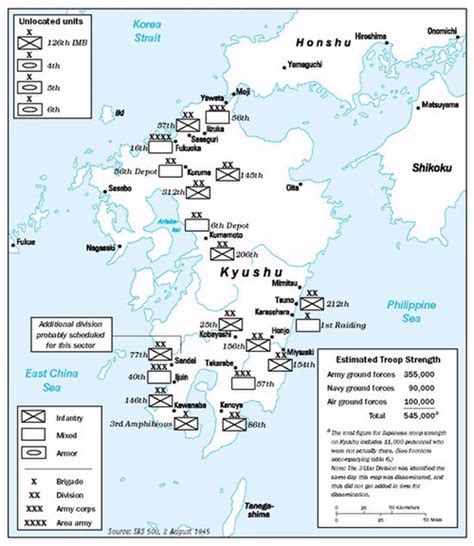
How many allied soldiers will be involved in the invasion of japan
At the same time he convened the meeting on the Bunker Hill, an old adversary, Vice Admiral Matome Ugaki, commanding the Japanese Fifth Air Fleet, said farewell to a group of volunteer flight crews preparing for a long-distance, one-way mission from Kyushu to attack the U.S. anchorage at Ulithi, miles to the southeast. Ugaki, who had served. Battle of okinawa deaths
This book is the Sensoroku (personal diary) of Imperial Japanese Navy Vice Admiral Matome Ugaki who was a key participant in the Pacific War. Operation downfall casualty estimates
Matome Ugaki (15 February – 15 August ) was a Vice Admiral of the Imperial Japanese Navy during World War II. Matome Ugaki was born on 15 February in Okayama Prefecture, Japan, and he graduated from the Imperial Japanese Navy Academy in Ugaki was promoted to Captain in and to Rear Admiral in , and he became Chief-of-Staff of the Combined Fleet under Isoroku.